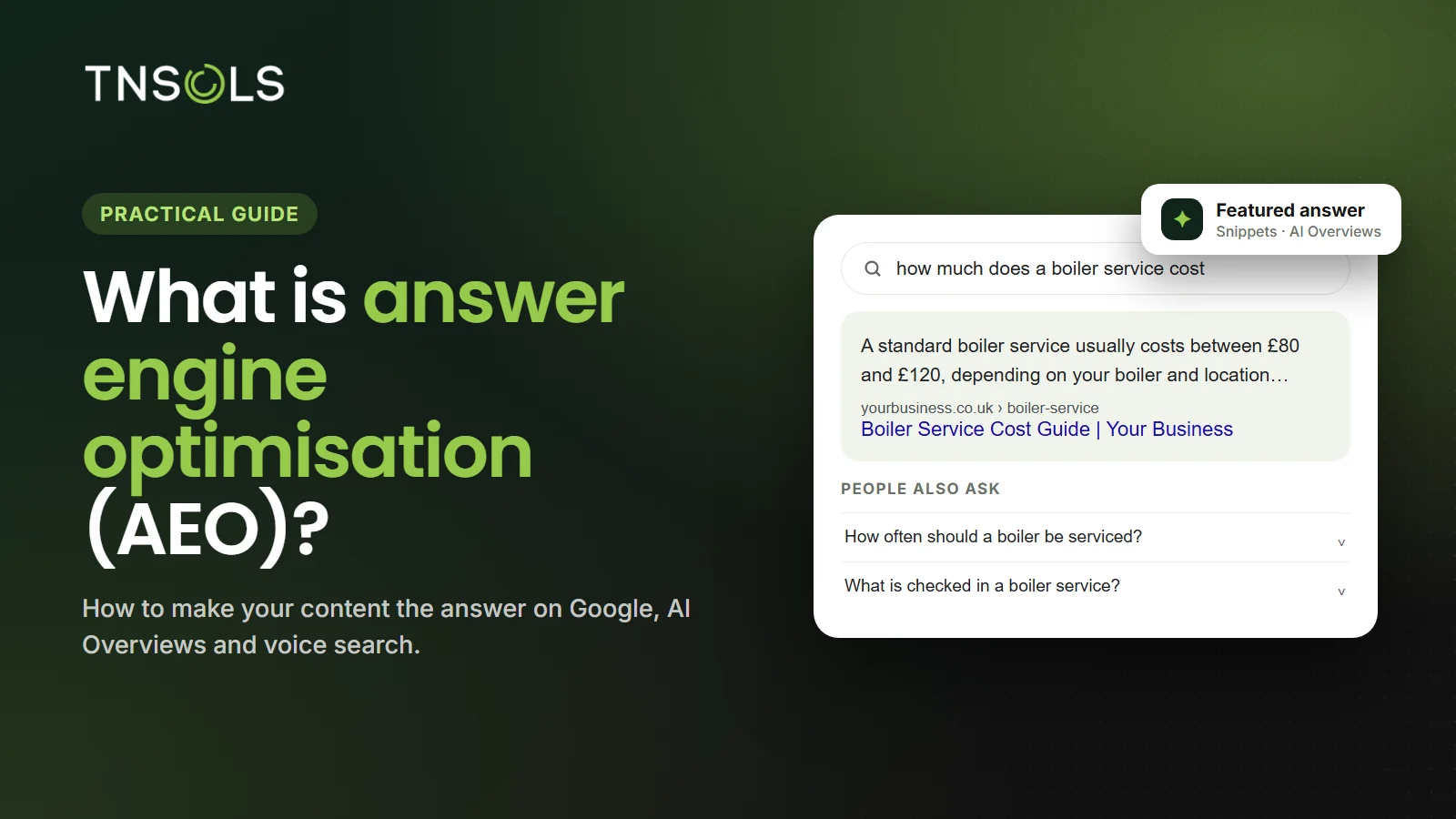
Answer engine optimisation (AEO) is the practice of making your content the direct answer to people’s questions in search, so that Google’s featured snippets, “People also ask” boxes, AI Overviews and voice assistants quote your business. Instead of only ranking a link, AEO helps you become the answer people see or hear first.
This guide explains what AEO is, how it differs from SEO and GEO, and the practical steps to structure your content so search engines choose it as the answer.
What is answer engine optimisation?
An “answer engine” is a search experience that answers a question directly instead of only listing websites. On Google, that includes:
- Featured snippets: the highlighted answer box at the top of some results.
- “People also ask”: the expandable list of related questions and short answers.
- AI Overviews and AI Mode: AI-generated summaries with links to the sources they draw on.
- Voice assistants: spoken answers from Google Assistant, Siri and Alexa.
AEO is everything you do to make your content the best candidate for those answers: finding the right questions, answering them clearly and structuring your pages so search engines can extract the answer with confidence.
AEO vs SEO: what is the difference?
SEO is about ranking your pages in search results. AEO focuses on being the answer itself. The foundations are shared, because search engines usually pick answers from pages they already trust and rank, but AEO puts more weight on:
- questions rather than only short keywords;
- short, quotable answers at the start of sections;
- page structure: clear headings, lists, steps and tables;
- structured data that describes your business and content.
AEO vs GEO
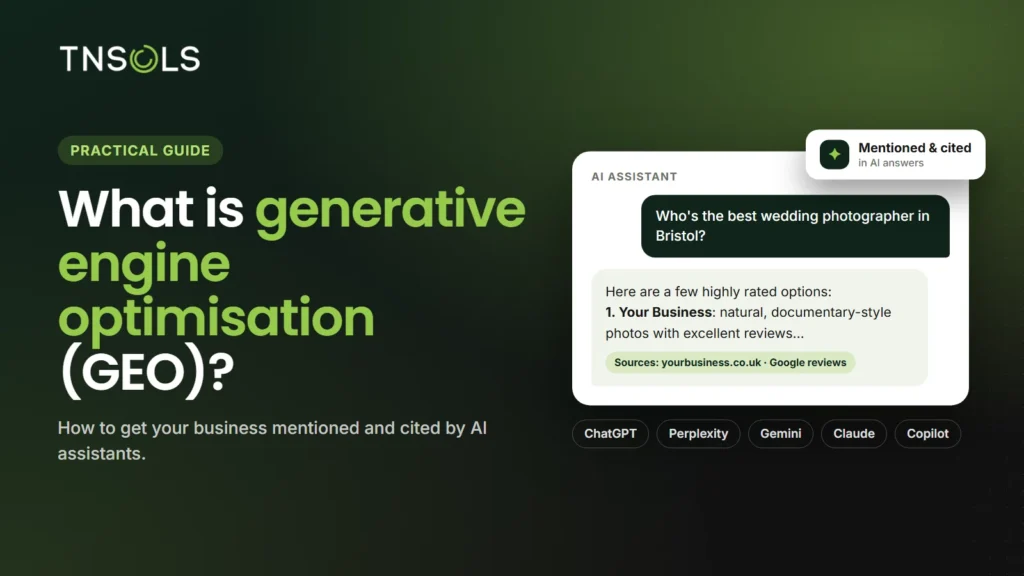
AEO is mainly about answers inside search engines. Generative engine optimisation (GEO) is about being mentioned and cited in answers written by AI assistants such as ChatGPT and Perplexity, which depends heavily on your reputation across the web. The two overlap, especially in Google’s AI Overviews. Read our guide to generative engine optimisation (GEO) to learn more.
How to do answer engine optimisation: 7 practical steps
1. Research the questions your customers ask
Start with the questions behind your best leads. Look at “People also ask” boxes for your main services, Google’s autocomplete suggestions, questions customers ask on calls and emails, forums such as Reddit, and the questions people put to AI tools. Group them by topic and buying stage, from “what is” to “how much” to “which is best”.
2. Put the answer first
For each question, give a direct answer of roughly 40 to 60 words straight after the heading, then expand with detail, examples and context. Use the question, or a close version of it, as the heading. This “answer first” pattern makes it easy for search engines to lift your answer, and it’s better for readers too.
3. Match the format to the question
- “What is” and “why” questions: a short definition paragraph.
- “How to” questions: numbered steps.
- “Best”, “types” and “examples” questions: a bulleted list.
- Comparisons and prices: a simple table.
4. Build helpful FAQ and how-to content
Add focused FAQ sections to service pages and create guides that answer the questions your competitors skip. Keep each answer genuinely useful, not a sales pitch, and keep it up to date.
5. Add structured data
Use structured data that fits your pages, such as Organization, LocalBusiness, Product, Article and FAQ markup. It helps search engines understand your business and content, even where it doesn’t create a special search result.
6. Show expertise and trust
Search engines prefer answers from sources they trust. Show who wrote the content and why they’re qualified, cite reliable sources, keep business details accurate and earn genuine reviews. For local businesses, a complete Google Business Profile matters for voice and “near me” answers.
7. Track which answers you win
Monitor the featured snippets and “People also ask” placements you hold for your key questions, check whether your pages are cited in AI Overviews, and use Google Search Console to see which queries bring impressions and clicks. Improve the answers you lose and fill the gaps you find.
Common AEO mistakes to avoid
- Burying the answer under long introductions.
- Writing for keywords instead of questions.
- Using the same generic FAQ on every page.
- Ignoring page speed and mobile, which still matter for every search feature.
- Expecting guarantees. Google decides which answer to show, and it changes often.
Is AEO worth it for small businesses?
Yes. Many of the questions customers ask are specific: about prices, locations, processes and comparisons. Small and local businesses are often best placed to answer them well, and a clear answer can put you in front of a customer before they’ve even visited a website.
Frequently asked questions about AEO
What does AEO stand for?
AEO stands for answer engine optimisation (or answer engine optimization in US spelling).
Is AEO replacing SEO?
No. Answer engines usually choose answers from pages that already rank well, so AEO builds on SEO rather than replacing it.
How long does AEO take?
Restructured pages can be picked up within weeks once Google re-crawls them. Winning competitive answers usually takes a few months of steady work.
Can you guarantee a featured snippet?
No one can. You can make your content the strongest candidate, but Google decides which answer to show.
Get help with answer engine optimisation
TnSols helps businesses research the right questions, restructure their content and win more answers in Google and AI Overviews. Explore our AEO services, see our full AI SEO services, or start with a free SEO audit.

Tayyab founded TnSols in 2018 to help businesses grow online with websites that rank and convert. He studied Software Engineering at Lancaster University and leads the team across design, development, SEO and marketing.
More about our team →