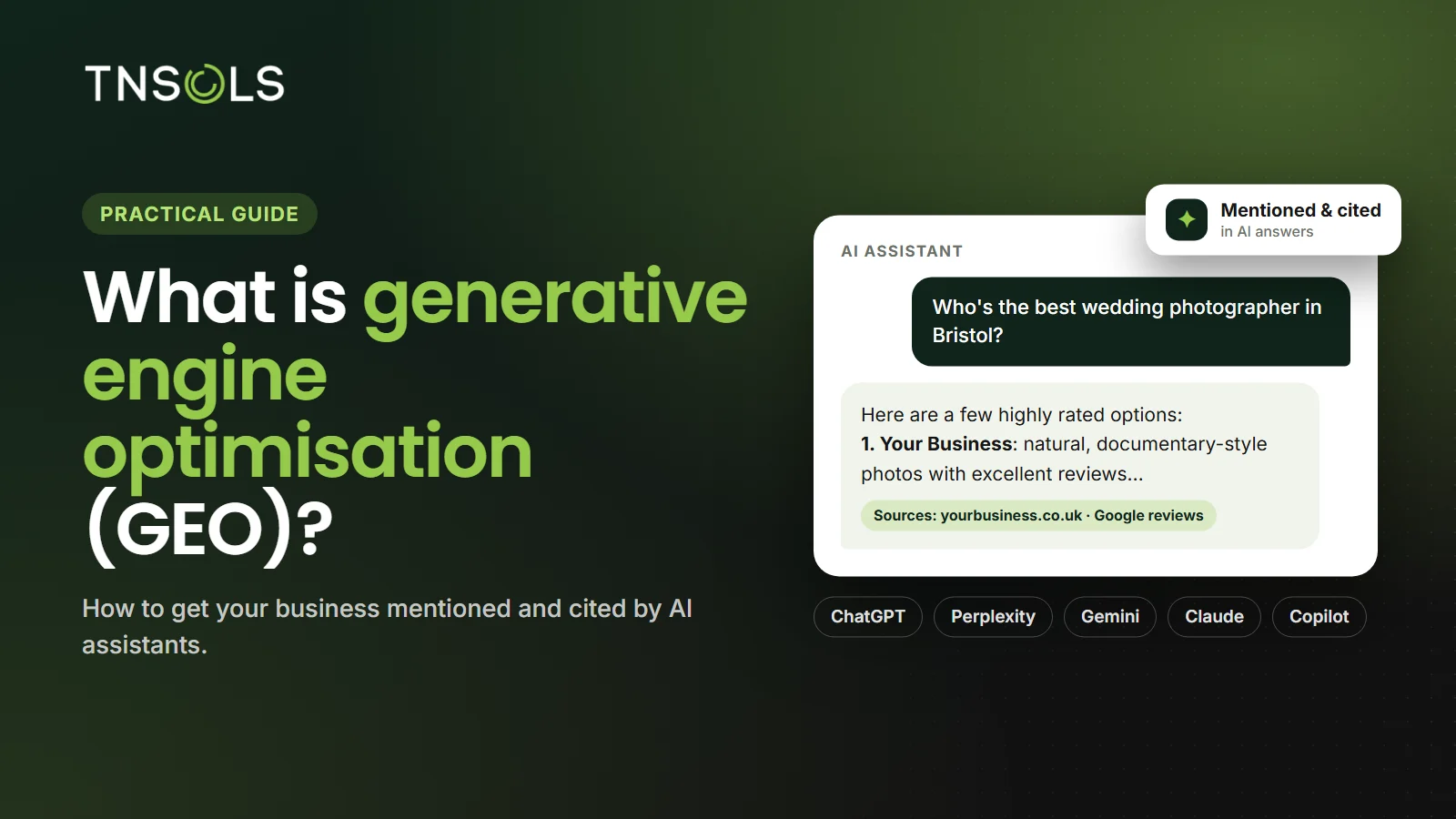
Generative engine optimisation (GEO) is the practice of making your business more likely to be mentioned, cited and recommended in answers written by AI tools such as ChatGPT, Perplexity, Google Gemini, Claude and Microsoft Copilot. Where traditional SEO aims to rank a page in a list of links, GEO aims to get your brand and your content into the answer itself.
This guide explains what GEO is, where the term comes from, how it differs from SEO and AEO, and the practical steps that help AI assistants find, trust and recommend your business.
What is generative engine optimisation?
A “generative engine” is any search tool that writes an answer for the user instead of only showing a list of results. ChatGPT with search, Perplexity, Gemini, Copilot and Google’s AI Overviews all work this way: they gather information from several sources and summarise it in their own words, often with links to the sources they used.
Generative engine optimisation is everything you do to improve how often, and how favourably, your business appears in those answers. That includes:
- being mentioned when someone asks for a recommendation in your market;
- being cited as a source, with a link back to your website;
- being described accurately: what you do, where you work and why people choose you.
You may also see GEO called LLM SEO, ChatGPT SEO or AI search optimisation. They describe the same goal: visibility in answers produced by large language models (LLMs).
Where does the term GEO come from?
The term was introduced in a research paper titled “GEO: Generative Engine Optimization” by researchers including Pranjal Aggarwal and Karthik Narasimhan, first published in November 2023 and presented at the KDD 2024 conference. The authors built a benchmark of real-world queries and tested how different changes to web content affected its visibility in AI-generated answers.
Two findings from that paper are especially useful for businesses:
- According to the authors, the right content changes could boost visibility by up to 40% in generative engine responses in their tests.
- Keyword stuffing did not perform well. Methods such as adding relevant statistics, quotations and citations from credible sources showed the strongest improvements.
In other words, the tactics that help most with AI answers look a lot like good, evidence-based writing, not old-fashioned keyword tricks.
GEO vs SEO vs AEO: what is the difference?
The three overlap, and the best results usually come from doing all of them together.
| SEO | AEO | GEO | |
|---|---|---|---|
| Main goal | Rank your pages in search results | Become the direct answer in search | Be mentioned and cited in AI-written answers |
| Where it shows | Google and Bing results pages | Featured snippets, “People also ask”, AI Overviews, voice assistants | ChatGPT, Perplexity, Gemini, Claude, Copilot |
| What matters most | Relevance, technical health, links | Clear, structured, quotable answers | Reputation across the web, citable content, clear brand details |
| How it is measured | Rankings, clicks, traffic | Snippets and answer placements won | Mentions, citations and AI referral traffic |
If you want a deeper look at answers inside Google itself, read our guide to answer engine optimisation (AEO).
How do AI assistants decide which businesses to recommend?
Each AI tool works differently, and none of them publish exactly how they choose sources. But they all have to rely on what they can find and trust about you. In practice, that comes down to four things:
- What the web says about you. Reviews, press coverage, directory listings, “best of” lists and mentions on trusted websites all shape how AI tools describe and rank businesses.
- What your own website says. Clear, specific, well-structured pages are easier for AI to understand and quote.
- Whether AI can access your site. Tools that search the web live need to be able to crawl and read your pages.
- Consistency. When your name, services, location and contact details match everywhere, AI tools can be more confident about who you are.
How to do generative engine optimisation: 8 practical steps
1. Find out what AI says about you today
Write down the questions your customers ask before they buy, such as “best accountant for small businesses in Leeds” or “who builds Shopify stores in London”. Ask them in ChatGPT, Perplexity, Gemini and Copilot. Note whether you are mentioned, how you are described, which competitors appear and which websites are cited as sources.
2. Make your site readable for AI crawlers
Check your robots.txt file to make sure you are not accidentally blocking AI crawlers such as OpenAI’s OAI-SearchBot and GPTBot or PerplexityBot, unless you have a reason to. (Google-Extended is a separate robots.txt token that controls whether Google may use your content for its Gemini models.) Keep pages fast and make sure your important content is in the HTML, not hidden behind scripts or logins.
3. Write answer-first, specific content
Start key pages and sections with a clear, one- or two-sentence answer, then add detail. Be specific: prices or price ranges, timescales, locations, who your service is for and what makes it different. Vague marketing copy gives AI nothing worth quoting.
4. Add evidence: statistics, quotes and sources
The GEO research found that adding statistics, quotations and citations from credible sources were among the most effective changes. Use real data where you have it, such as your own survey results, case study numbers or industry figures with a link to the source. Never make numbers up.
5. Strengthen your entity signals
Make sure your business name, address, phone number, services and social profiles are consistent across your website, Google Business Profile and directories. Add Organization or LocalBusiness structured data so machines can clearly connect the facts about your brand.
6. Earn mentions on the sites AI trusts
Look at the sources AI tools cite in your market: industry publications, comparison sites, local news, “best of” lists and review platforms. Getting featured there, through digital PR, expert commentary or partnerships, can influence what AI says about you.
7. Grow and respond to reviews
AI assistants often summarise what customers say. A steady flow of genuine, detailed reviews on Google and the platforms that matter in your industry, with thoughtful replies, helps you become the safe recommendation.
8. Track, measure and repeat
Re-run your list of prompts every month and record mentions, descriptions and cited sources. In Google Analytics, look for referral traffic from sources such as chatgpt.com, perplexity.ai and copilot.microsoft.com. GEO is ongoing work, and AI answers change often.
Common GEO mistakes to avoid
- Keyword stuffing. It didn’t help in the original GEO research, and it makes your content worse for people.
- Blocking AI crawlers by accident. Some security plugins and CDN settings block bots you may want.
- Thin, generic pages. If your page says the same as everyone else’s, there is no reason to cite it.
- Ignoring your reputation off-site. Your own website is only part of what AI tools read.
- Expecting guarantees. No one can promise what an AI tool will say. Focus on the signals you can improve and measure.
Does GEO replace SEO?
No. Many AI answers draw on pages that already perform well in search, and the foundations are the same: a fast, crawlable site, helpful content and a trustworthy brand. Think of GEO as an extension of SEO for the way people increasingly search, not a replacement for it.
Frequently asked questions about GEO
Is GEO the same as LLM SEO?
Broadly, yes. LLM SEO, ChatGPT SEO and GEO all describe improving your visibility in answers generated by large language models.
How long does GEO take to work?
Tools that search the web live, such as Perplexity and ChatGPT search, can pick up changes to your site within weeks. Building the wider reputation that AI tools rely on usually takes several months.
Can small businesses benefit from GEO?
Yes. Local and niche businesses often have an advantage, because AI tools look for specific, trusted answers, and many competitors haven’t optimised for AI search yet.
Can someone guarantee my business will appear in ChatGPT?
No honest agency can guarantee that, because AI tools write their own answers and change often. Be wary of anyone who promises it.
Get help with generative engine optimisation
At TnSols, we combine SEO, content and web development to help businesses get mentioned and cited by AI assistants. Explore our GEO services, see how they fit into our wider AI SEO services, or start with a free SEO audit.

Tayyab founded TnSols in 2018 to help businesses grow online with websites that rank and convert. He studied Software Engineering at Lancaster University and leads the team across design, development, SEO and marketing.
More about our team →